
How Alcohol Disrupts REM Sleep
You drink in the evening, feel relaxed, become drowsy, and fall asleep faster than usual. Because of that, many people think alcohol helps them sleep.
Science-backed guidance, AI-powered insights, and trusted solutions for deeper, more restorative sleep.
Research-informed
Context and practical limits are explained clearly.
Educational, not diagnostic
Guidance does not replace clinical care.
Transparent disclosures
Affiliate relationships are disclosed where relevant.
Safety-aware
Concerning symptoms should be discussed with a clinician.
Identify your main sleep challenge to get personalized guidance.
You drink in the evening, feel relaxed, become drowsy, and fall asleep faster than usual. Because of that, many people think alcohol helps them sleep.
It helps you wake up, focus, work longer, train harder, and get through the afternoon slump. But caffeine does not give you energy in the same way sleep does.
During the day, you may stay busy enough to keep moving. You answer messages, finish tasks, handle conversations, commute, exercise, eat, and distract yourself with screens or responsibilities.
Then one video becomes five. One message becomes a conversation. One quick scroll becomes 40 minutes of news, social media, shopping, work email, or short-form video.
Sleep debt is what happens when you repeatedly get less sleep than your body needs.
For some people, it is mostly an annoying sound. For others, it can be a warning sign that breathing is being restricted during sleep.
Complete topic library
Browse every published sleep problem, goal, guide, review, and comparison in one place.
20 published articles
Understand why sleep often becomes lighter with age, which changes are common, and what may help.
Read articleYou drink in the evening, feel relaxed, become drowsy, and fall asleep faster than usual. Because of that, many people think alcohol helps them sleep.
Read articleIt helps you wake up, focus, work longer, train harder, and get through the afternoon slump. But caffeine does not give you energy in the same way sleep does.
Read articleIt does not work like a sleeping pill. It does not make you instantly tired at night. Instead, it helps set the timing system that controls when your body feels awake and when it becomes ready for sleep.
Read articleThen one video becomes five. One message becomes a conversation. One quick scroll becomes 40 minutes of news, social media, shopping, work email, or short-form video.
Read articleCreate a repeatable evening transition that lowers stimulation and protects the connection between bed and sleep.
Read articleMove problem-solving out of bed and use a repeatable response to racing thoughts, with clear boundaries for seeking help.
Read articleAudit the interruptions that actually wake you, then test one practical change before buying more sleep products.
Read articleYou start thinking about tomorrow, replaying conversations, checking the time, calculating how much sleep you have left, or worrying that another bad night is beginning.
Read articleYou can spend 8 hours in bed and still wake up tired if your sleep is fragmented, poorly timed, too light, or disrupted by caffeine, alcohol, stress, screens, noise, temperature, or breathing problems.
Read articleYou may decide to go to bed earlier, but when bedtime arrives, your brain may still feel alert. You may lie in bed tired but awake, scroll for “just a few minutes,” or finally feel sleepy much later than planned.
Read articleMost people briefly wake between sleep cycles. These awakenings may last only a few seconds, and you may not remember them in the morning.
Read articleYou can spend 8 hours in bed and still wake up tired if your sleep was fragmented, your body clock was misaligned, your caffeine timing was too late, alcohol disrupted your REM sleep, or stress kept your nervous system on alert.
Read articleSleep debt is what happens when you repeatedly get less sleep than your body needs.
Read articleFor some people, it is mostly an annoying sound. For others, it can be a warning sign that breathing is being restricted during sleep.
Read articleIt can help you feel alert, focused, motivated, and ready to start the day. For many people, morning coffee is not just a drink — it is a ritual.
Read articleDuring the day, you may stay busy enough to keep moving. You answer messages, finish tasks, handle conversations, commute, exercise, eat, and distract yourself with screens or responsibilities.
Read articleUnderstand why you can feel tired but stay awake, what to change first, and when ongoing sleep-onset trouble needs evaluation.
Read articleYou may open your eyes at 2:37 a.m., check the clock, and immediately start worrying: “Why am I awake again?” “Will I be tired tomorrow?” “What if I can’t fall back asleep?”
Read articleYou may wake up with heavy eyes, brain fog, low motivation, or the feeling that your body never fully recovered. You might even wonder whether sleep “works” for everyone else but not for you.
Read articleFind the sleep pattern that best matches your nights and get a more accurate improvement path.
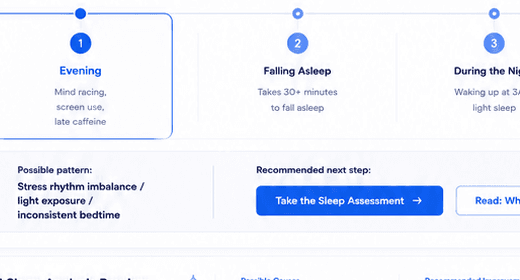
Mind racing, screen use, late caffeine
Takes 30+ minutes to fall asleep
Waking at 3AM, light sleep
Wake up tired, brain fog
Possible pattern
Possible pattern: stress rhythm imbalance
Tell us about your goals and our AI will analyze possible factors and create a personalized plan for you.
Learn what affects your energy and identify triggers
5 min readImprove sleep, nutrition, and daily habits
6 min readUse proven supports to restore energy
7 min readBuild a sustainable routine for long-term vitality
8 min readGet your personalized sleep plan in under 2 minutes.